20+ years of driveway DIY — oil changes, brakes, rotors, and real car maintenance
Updated July 202610 min read
As an Amazon Associate, This Will Fix It earns from qualifying purchases at no extra cost to you. MPG improvement claims are sourced from the US Department of Energy, Standard Drivetrain independent testing (2026), GearJunkie hands-on testing (March 2026), and verified Amazon buyer reviews.
3.3%
MPG lost per 10 PSI of underinflation — US Department of Energy
$400+
Annual fuel savings possible from combining all 5 fixes on a 25 MPG vehicle
$32
Cost of the AstroAI tire inflator — the highest-impact single fuel efficiency fix
Start here — highest MPG impact per dollar spent
AstroAI L7 Cordless Tire Inflator — Fix the #1 MPG Killer First
Underinflated tires are the most common and most overlooked fuel efficiency problem on most vehicles — and a cordless digital tire inflator is the fix. The AstroAI L7 is GearJunkie tested, 4.8 stars on Amazon from over 1,000 verified buyers, 150 PSI cordless with auto shut-off and a digital display. Takes 5 minutes to check and correct all four tires. The US Department of Energy estimates tires underinflated by just 10 PSI reduce fuel economy by up to 3.3 percent. At current gas prices, correctly inflated tires pay for this inflator in under two months.
Gas costs more every year, your car’s fuel economy has drifted below what it used to be, and nobody told you which fixes actually move the needle versus which ones are just marketing claims.
Fix
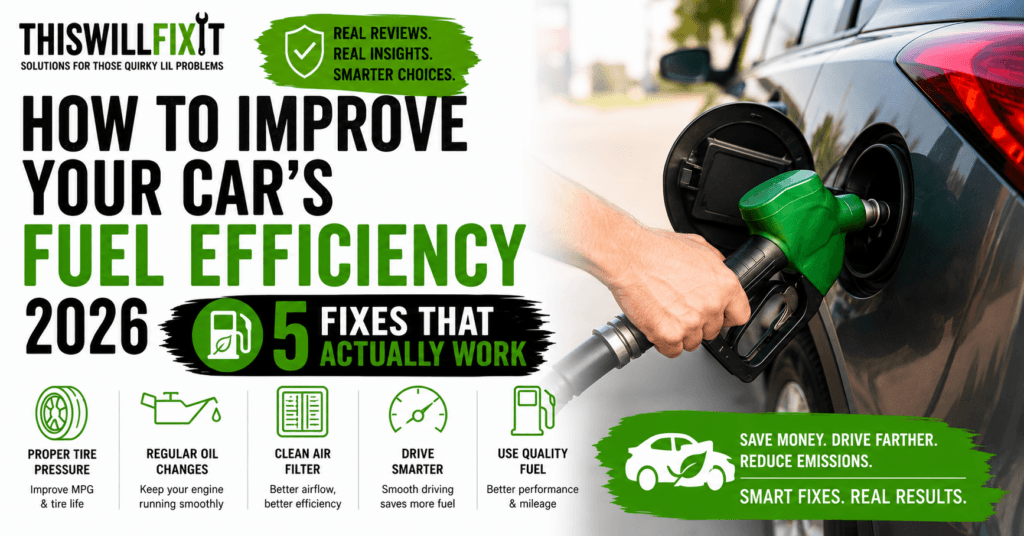
Five driveway maintenance fixes — correct tire pressure, fuel system cleaning, air filter, real-time MPG monitoring, and synthetic oil — that together can add 2 to 5 MPG to almost any vehicle.
Relief
Fill up less often, spend less every month on gas, and know exactly which maintenance items are affecting your car’s performance — without guessing or overpaying at a shop.
The 5 Fixes That Actually Improve MPG — With Real Numbers
I’ve been maintaining my own vehicles for over 20 years. In that time I’ve seen a lot of products claim to improve fuel economy — most of them don’t deliver. The five fixes below are different. Each one addresses a specific, documented cause of reduced fuel economy. Each one has measurable, independent verification behind the MPG claim. And every one of them is something you can do yourself in your driveway without a lift or special tools.
The most important thing to understand upfront is that no single fix produces dramatic results on its own. A car getting 25 MPG is not going to jump to 32 MPG from one product. But a combination of correctly inflated tires, clean injectors, a fresh air filter, full synthetic oil, and real-time MPG awareness can realistically add 2 to 5 MPG — and keep those gains consistent over time because you’re monitoring them.
Correct tire pressure
+0.5–3.3%
US Dept of Energy
PEA fuel system cleaner
+1–3%
Standard Drivetrain 2026
High-flow air filter
+1–2%
K&N published testing
Full synthetic motor oil
+1–2%
Consumer Reports testing
Real-time MPG monitor
+5–15%
Behavioral — Oak Ridge National Lab
Combined — all five
+2–5 MPG
Realistic combined estimate
Watch-out — skip the snake oil: Fuel economy “booster” tablets, magnetic fuel line attachments, acetone additives, and hydrogen generators are not included on this list because independent testing consistently shows they deliver zero measurable MPG improvement. The Federal Trade Commission has issued warnings about fuel economy claims from aftermarket add-on devices. The five fixes below are the ones with actual independent verification behind them.
AstroAI L7 Cordless Tire Inflator — 150 PSI, Auto Shut-Off
~$32
Underinflated tires are the most common, most overlooked, and most DIY-fixable fuel economy problem on most vehicles — and the AstroAI L7 is the right tool to fix it. GearJunkie’s March 2026 hands-on testing confirmed the AstroAI as their best value pick for most car owners — compact enough for a glove compartment, accurate enough for reliable tire inflation, and rated 4.8 stars from over 1,000 Amazon buyers. The digital display shows preset and current pressure simultaneously. Auto shut-off cuts inflation precisely at your target PSI — no guesswork, no overinflation. Cordless battery operation means you can use it anywhere — driveway, parking lot, roadside. The US Department of Energy’s data is clear: tires underinflated by 10 PSI reduce fuel economy by up to 3.3 percent. At current gas prices and typical annual mileage, that’s real money leaving your pocket every month for a problem that takes 5 minutes and $32 to permanently fix.
Fixes the #1 MPG killer — underinflation — in 5 minutes for $32
Auto shut-off prevents overinflation — accurate to within 1 PSI
Cordless battery — works anywhere without needing the car running
Compact enough for glove compartment storage — always in the car when needed
Digital display shows target and current PSI simultaneously
Watch-outs
Battery needs charging — keep it plugged in at home between uses
Slower than 12V plug-in models on very flat tires — add 5 to 10 extra minutes
Not rated for heavy-duty truck tires — Viair 88P is the better choice for full-size trucks
Scott’s tip: The door jamb sticker tells you the correct tire pressure for your vehicle — not the number on the tire sidewall. The sidewall shows the maximum pressure the tire can hold, which is almost always higher than the correct operating pressure. Check the sticker on the inside of the driver’s door before inflating. Most vehicles call for 32 to 35 PSI — and most vehicles on the road are running 4 to 8 PSI low without the driver knowing because the TPMS warning light doesn’t trigger until you’re 25 percent underinflated.
Fix #2: Red Line SI-1 — The Fuel System Cleaner That Actually Works
Red Line SI-1 Complete Fuel System Cleaner — 15 oz
~$12
Standard Drivetrain’s 2026 independent testing scores the Red Line SI-1 at 9.7 out of 10 — the highest-rated fuel system cleaner in their evaluation of 10 products across 31,000 user reviews. The reason it tops every serious comparison is simple: Red Line SI-1 has the highest PEA (polyether amine) concentration of any retail fuel system cleaner available — confirmed at 30 to 40 percent per its published safety data sheet. PEA is the active chemistry that actually dissolves carbon deposits from fuel injectors, intake valves, and combustion chambers. Competing products either don’t disclose their PEA content or contain significantly less. One 15 oz bottle treats a full tank for deep cleaning — pour it in at fill-up. Amazon’s #1 bestseller in Fuel System Cleaners. Gasoline-only — not for diesel engines. Most noticeable improvement on high-mileage vehicles and direct injection engines that accumulate intake valve deposits quickly.
Standard Drivetrain 9.7/10Highest PEA concentrationAmazon #1 bestsellerOne treatment deep clean~$12
Scott’s tip: Add the Red Line SI-1 to a nearly empty tank right before filling up — this way the cleaner mixes thoroughly with a full tank of fresh fuel and cycles through the entire fuel system during the next several hundred miles. Don’t add it to a full tank where it gets diluted immediately before it can concentrate at the injectors. Use it every 15,000 miles for maintenance or when you notice rough idle, hesitation, or a drop in fuel economy on a vehicle that’s otherwise running well.
K&N Drop-In High-Flow Air Filter — Vehicle-Specific Fit
~$50–70
K&N’s drop-in replacement air filter installs in exactly the same location as your factory paper filter — no modifications, no tools beyond removing the airbox cover. The oiled cotton gauze construction flows more air than a paper filter while still capturing particles, and it is washable and reusable for the life of the vehicle. The MPG improvement from a K&N is most significant when replacing a dirty or clogged factory filter — on a vehicle with a recently replaced paper filter, the gain is smaller. The long-term value case is straightforward: a K&N costs $50 to $70 once versus $15 to $25 every 12,000 to 15,000 miles for replacement paper filters. Over a typical 10-year vehicle ownership period, the K&N pays for itself several times over in avoided replacement costs. Search “K&N [your year/make/model]” on Amazon to find the exact drop-in replacement for your vehicle — K&N makes vehicle-specific filters for virtually every car sold in the US.
Vehicle-specific drop-in fitWashable — reusable for lifeNo modification neededBetter than paper on flowPays for itself long-term
Fix #4: ScanGauge II — See Your MPG in Real Time and Change How You Drive
ScanGauge II — Real-Time Fuel Economy Monitor + OBD2 Scanner
~$170
Oak Ridge National Laboratory research confirms that drivers who can see their real-time fuel economy while driving improve their MPG by 5 to 15 percent within weeks — not from any hardware change, but from changed driving behavior. Seeing instantaneous MPG drop to zero during aggressive acceleration and spike during gentle deceleration changes how you drive permanently. The ScanGauge II plugs into your OBD2 port and displays real-time MPG, instant fuel consumption, trip average, estimated range, coolant temperature, and over 80 OBD2 parameters simultaneously on four configurable gauges. It also reads and clears trouble codes — functioning as an OBD2 scanner in addition to a fuel economy monitor. No subscription. Works on any 1996+ vehicle. The most expensive product on this list but the one with the highest potential MPG impact for a driver who tends toward aggressive acceleration.
Fix #5: Mobil 1 Full Synthetic Motor Oil — Less Friction, More MPG
Mobil 1 Full Synthetic Motor Oil — 5W-30 or Vehicle Spec Viscosity
~$30–45 per change
Consumer Reports and Car and Driver long-term testing both document a consistent 1 to 2 percent fuel economy improvement when switching from conventional to full synthetic motor oil — from reduced internal engine friction. Full synthetic oil flows more easily at cold start, reaches operating viscosity faster, and maintains its protective film at higher temperatures than conventional oil. On a vehicle doing 15,000 miles per year, a 1.5 percent MPG improvement translates to $30 to $50 in annual fuel savings. Combined with the extended drain intervals that full synthetic enables — typically 7,500 to 10,000 miles versus 3,000 to 5,000 for conventional — the cost-per-mile difference between conventional and synthetic narrows significantly. Use the viscosity specified in your owner’s manual — do not substitute a lighter viscosity hoping for more MPG gains, as this can cause oil pressure issues on some engines.
How to Check Tire Pressure for Maximum Fuel Efficiency
1
Find your vehicle’s correct tire pressure — not the tire sidewall number
Check the sticker inside the driver’s door jamb. This shows the manufacturer’s recommended PSI for your specific vehicle and tire size. The number molded into the tire sidewall is the maximum pressure the tire can hold — not the correct operating pressure. Using the sidewall number overinflates your tires and reduces handling and contact patch.
2
Check tires cold — before driving
Check tire pressure when the vehicle has been sitting for at least 3 hours or driven less than 1 mile. Driving heats air inside the tire and raises pressure by 4 to 6 PSI — measuring after driving gives a false reading. First thing in the morning is the ideal time for accurate cold pressure readings.
3
Set the inflator to your target PSI and inflate all four tires
Set the AstroAI L7 to the target PSI from the door jamb sticker. The auto shut-off stops inflation exactly at your target. Check all four tires — front and rear sometimes have different target pressures on some vehicles, particularly rear-wheel-drive sports cars and some SUVs. Always check the spare if it’s a full-size spare that you might actually drive on.
4
Check monthly and when temperature changes significantly
Tire pressure drops by approximately 1 PSI per month and 1 PSI for every 10 degree Fahrenheit temperature drop in ambient temperature. A car sitting through fall into winter can easily be 6 to 8 PSI underinflated by January without triggering the TPMS warning light — which doesn’t activate until 25 percent underinflation. Set a monthly calendar reminder and always check before a long highway trip.
Related fix: A fuel efficiency check is the perfect time to run an OBD2 scan too — some trouble codes directly affect fuel economy without triggering obvious symptoms. Our guide to best OBD2 scanners 2026 covers the BlueDriver Pro and four alternatives — and how to identify codes that are quietly hurting your MPG.
Common Questions About Improving Fuel Efficiency
The most impactful single fix is correct tire pressure — underinflated tires are the most common and most overlooked MPG killer on most vehicles. The US Department of Energy states tires underinflated by just 10 PSI reduce fuel economy by up to 3.3 percent. A portable tire inflator with an accurate digital gauge costs $25 to $40 and pays for itself within weeks. Beyond tires, switching to full synthetic oil, using a PEA-based fuel system cleaner, and replacing a clogged air filter all deliver measurable MPG improvements.
Yes — PEA-based fuel system cleaners like Red Line SI-1 genuinely improve MPG in vehicles with carbon buildup on injectors or intake valves. The improvement is most noticeable on high-mileage vehicles (50,000+ miles) and direct injection engines. Red Line SI-1 has the highest PEA concentration of any retail fuel system cleaner — Standard Drivetrain’s 2026 independent testing scores it 9.7 out of 10. For vehicles with clean injectors and recent maintenance, improvement is smaller but still present.
The US Department of Energy states properly inflated tires improve gas mileage by 0.5 to 3 percent. Tire pressure drops naturally — about 1 PSI per month and 1 PSI for every 10 degree Fahrenheit temperature drop. A vehicle sitting through winter without a pressure check can easily be 5 to 8 PSI underinflated by spring. The TPMS warning light doesn’t activate until 25 percent underinflation — meaning most underinflation goes undetected without a manual check.
Yes — switching from conventional to full synthetic motor oil produces a consistent 1 to 2 percent fuel economy improvement from reduced internal friction, well-documented across Consumer Reports and Car and Driver long-term testing. On a vehicle traveling 15,000 miles per year, a 1.5 percent improvement in fuel economy saves $30 to $50 annually at current gas prices. Combined with longer drain intervals that full synthetic enables, the cost difference between conventional and synthetic narrows significantly over a full year.
The three highest-impact habits are: avoiding aggressive acceleration from stops (can reduce MPG by 15 to 30 percent in city driving), maintaining steady highway speed with cruise control (varying speed repeatedly burns significantly more fuel), and reducing idle time (a modern engine burns 0.15 to 0.3 gallons per hour at idle — which is zero MPG). A real-time fuel economy monitor like the ScanGauge II makes these habits visible immediately and produces behavioral MPG gains of 5 to 15 percent according to Oak Ridge National Laboratory research.
On modern fuel-injected vehicles, a clean high-flow air filter has a smaller direct MPG impact than on older carbureted engines — the engine’s mass airflow sensor compensates for airflow changes. The main benefit is restored engine performance, which means less throttle needed for normal acceleration — an indirect MPG gain. K&N’s washable drop-in filters are reusable for vehicle life and cost less than three sets of paper replacement filters over a typical ownership period, making them a long-term value even beyond the MPG benefit.
20+ years of driveway DIY — oil changes, brakes, rotors, filters, and real car maintenance
The fuel efficiency fixes that work are the boring ones — correct tire pressure, clean fuel system, fresh oil. Not the gimmicks. I’ve been doing my own oil changes and maintenance for over 20 years and the biggest MPG improvement I ever saw was simply keeping tires correctly inflated through winter. Read more about Scott’s approach →
Ready to start saving on gas?
Start with the AstroAI L7 tire inflator — the highest-impact, lowest-cost fuel efficiency fix available. Five minutes and $32 to fix the #1 MPG killer on most vehicles.